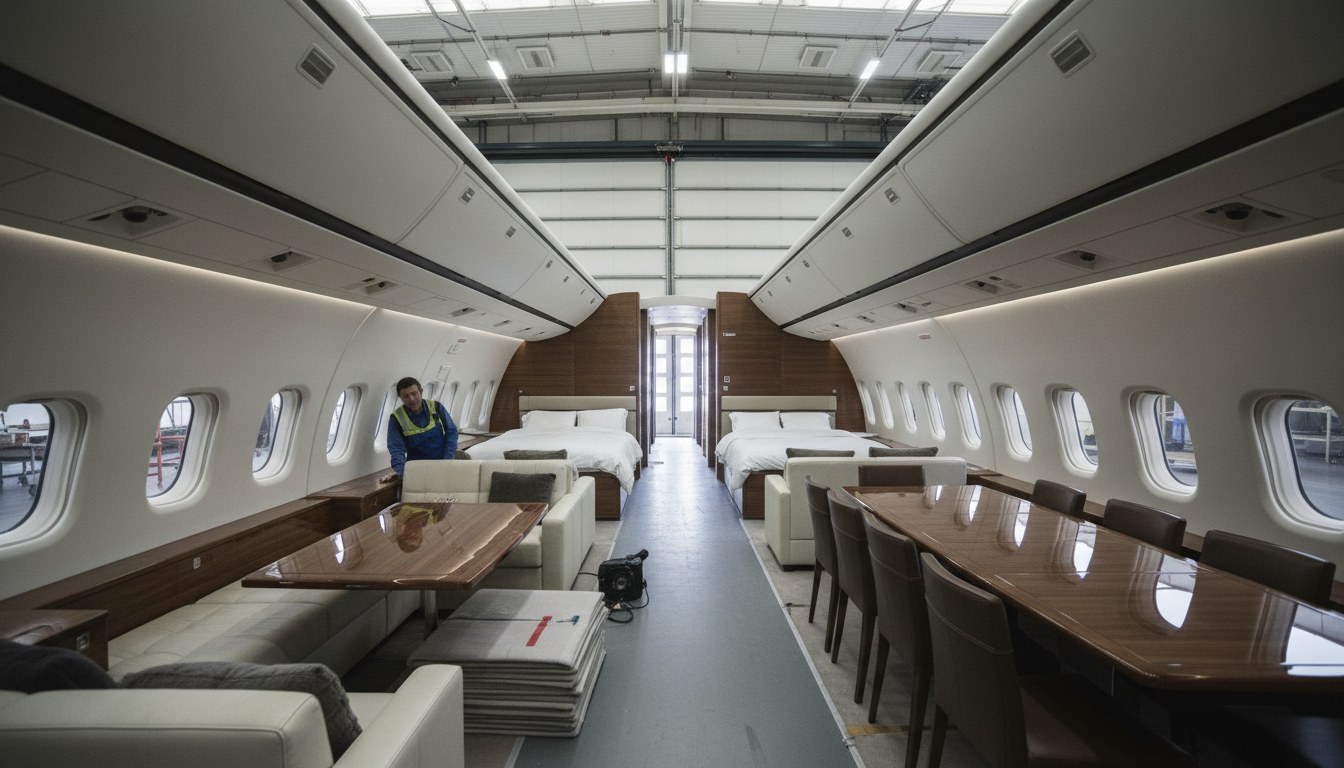
Completion centers report growing order books for Airbus Corporate Jets ACJ320neo conversions, reflecting ultra-high-net-worth demand for direct flights exceeding 12 hours without fuel stops. The ACJ320neo platform, derived from the commercial A320neo airliner, offers substantially larger cabins than purpose-built business jets while maintaining intercontinental range capabilities. Wealth concentration in markets like Asia-Pacific and the Middle East has created demand for point-to-point connectivity between financial centers that traditional large-cabin jets struggle to serve with adequate passenger space. Unlike purpose-built aircraft constrained by business aviation development budgets, airline-derived platforms leverage commercial aviation's massive economies of scale. The ACJ320neo's cabin cross-section matches commercial airline dimensions, enabling configurations that would be impossible in conventional business jets. Completion centers describe projects featuring full bedrooms, conference rooms, and lounge areas that approach residential scale.
Why it matters
The shift toward airline-derived VIP aircraft signals a fundamental change in ultra-luxury aviation requirements. Traditional business jets evolved from smaller commercial aircraft or were purpose-built for shorter missions. As wealth becomes increasingly concentrated among individuals capable of sustaining private aircraft operations, the economics favor platforms that maximize living space over flight deck efficiency. This trend challenges established business aviation manufacturers who have invested heavily in purpose-built platforms optimized for traditional charter and fractional ownership models rather than individual ownership of airline-scale aircraft.
Impact on Charter Market
Charter operators face complex positioning decisions with ACJ-class aircraft. The platforms command premium rates but require specialized ground handling, maintenance capabilities, and crew training that mirror commercial aviation standards. Some operators report strong demand from corporate groups and family offices seeking to charter entire aircraft for extended international trips, particularly to destinations with limited commercial service. However, the aircraft's size limits deployment flexibility compared to traditional large-cabin jets that can access more airports and require less specialized ground support infrastructure.
Impact on Empty Legs
Empty leg opportunities with ACJ-class aircraft remain limited by their operational characteristics. The platforms typically fly between major international airports with commercial-grade infrastructure, creating fewer routing options than traditional business jets. When empty legs do become available, they often involve long-haul international sectors that appeal to a narrow customer base willing to accommodate the aircraft's airline-style operational requirements. The cabin size advantage becomes less relevant on empty leg flights where passengers cannot influence the interior configuration or service standards.
Key takeaways
• ACJ320neo conversions leverage commercial aviation economies of scale to deliver cabin space impossible in purpose-built business jets • Ultra-wealthy buyers increasingly prioritize direct routing capability over traditional business aviation operational flexibility • Completion centers report growing demand for residential-scale amenities in converted airline platforms • The trend reflects wealth concentration enabling individual ownership of airline-class aircraft for private use
Expert Opinion
The ACJ phenomenon represents aviation following wealth patterns rather than traditional market segments. Purpose-built business jets optimized for charter and fractional operations may struggle to compete with airline-derived platforms when individual buyers can sustain the higher operational costs in exchange for significantly larger living spaces. This shift could reshape the ultra-luxury segment around platforms designed for commercial service rather than business aviation's traditional operational model.
FAQ
What makes ACJ320neo different from traditional business jets?
The ACJ320neo uses a commercial airliner fuselage, providing cabin cross-sections and interior volume impossible in purpose-built business jets. It leverages airline manufacturing economies while offering intercontinental range, though it requires commercial-grade ground support and maintenance infrastructure.
Why are ultra-wealthy buyers choosing airline-derived aircraft?
Wealth concentration enables individuals to sustain higher operational costs in exchange for residential-scale cabin space and direct routing between global financial centers. Traditional business jets cannot match the living space possible in converted commercial platforms.
How do ACJ aircraft affect charter availability?
ACJ platforms serve a specialized charter market focused on extended international missions and corporate groups. Their size and operational requirements limit deployment flexibility compared to traditional business jets, creating fewer but potentially higher-value charter opportunities.
Sources
References used in this article
- Airbus Corporate JetsACJ platform specifications and capabilities
- Aviation WeekBusiness aviation market analysis and completion center trends
- EmptyJet Aircraft DatabaseBusiness jet specifications and market positioning