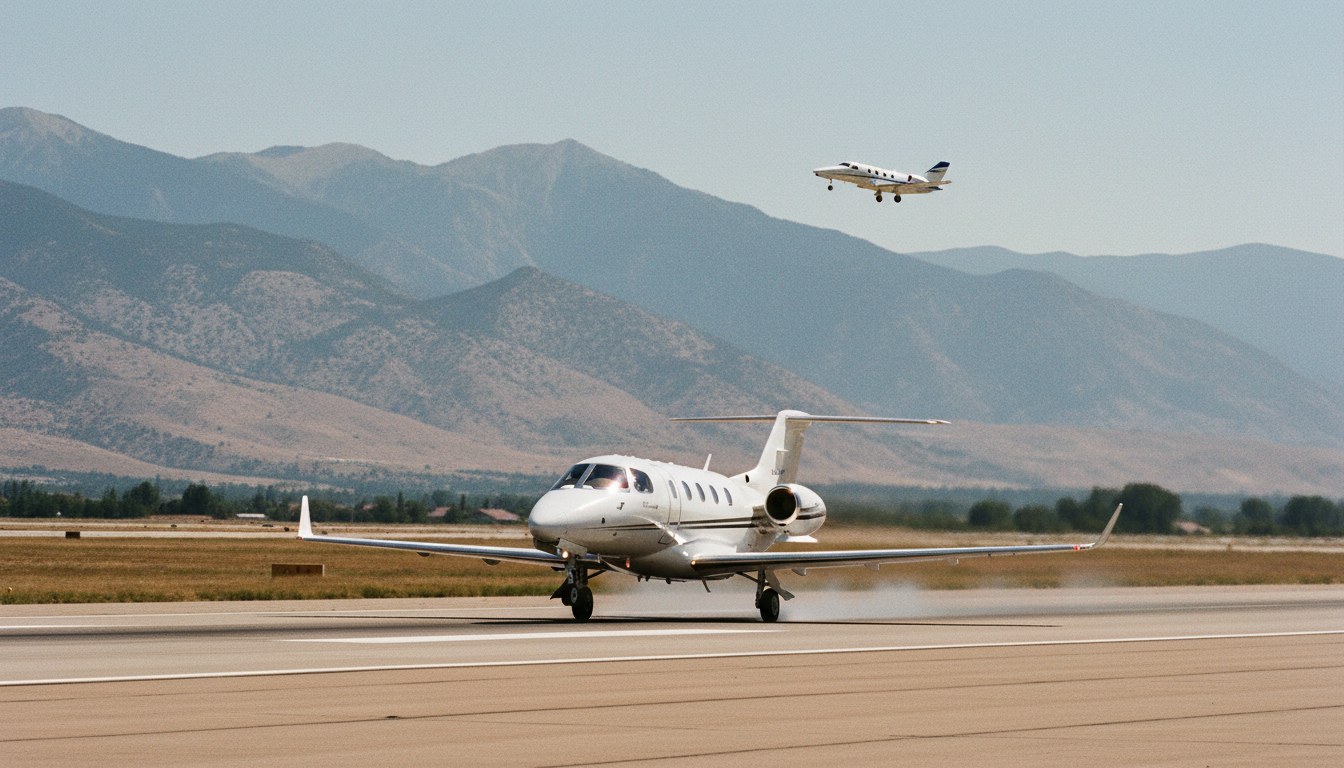
Last August, a Phenom 300E pilot discovered what Embraer's marketing materials don't advertise: his fully-loaded jet needed an extra 1,200 feet of runway to clear the mountains surrounding Aspen on a 95°F afternoon. The Citation CJ4 that departed minutes later? Business as usual.
This is the Phenom 300E's dirty secret. Despite claiming the title of world's most-delivered light jet for eleven consecutive years, Embraer's flagship suffers from a fundamental weakness that becomes glaringly apparent when density altitude climbs. While competitors like the CJ4 and HondaJet Elite maintain respectable performance in hot-and-high conditions, the 300E's twin Pratt & Whitney PW535E engines lose their edge precisely when you need it most.
The numbers tell the story. At sea level on a standard day, the Phenom 300E's 3,290-pound thrust output per engine delivers impressive takeoff performance from a 3,560-foot runway. But climb to Aspen's 7,820-foot elevation on a summer day when temperatures hit the mid-90s, and that same aircraft suddenly requires nearly 6,000 feet—if it can depart at full payload at all.
Embraer's own performance charts reveal the brutal math. At density altitudes above 8,000 feet—common at airports like Telluride, Sun Valley, and dozens of Western mountain destinations—the 300E's maximum takeoff weight drops by as much as 2,000 pounds. That's the difference between carrying six passengers with bags or flying with just four and minimal fuel.
The root cause isn't mysterious: the PW535E engines, while fuel-efficient and reliable, simply weren't designed with the same hot-and-high margins as their competitors. Cessna's CJ4 benefits from Williams FJ44-4A engines that maintain thrust more effectively in thin air, while HondaJet's over-wing engine configuration provides inherent advantages in these conditions.
Real-world operators have learned to plan around these limitations. Charter companies serving Western ski towns routinely block morning departures for the 300E during summer months, waiting for cooler afternoon temperatures that can recover several hundred feet of performance. Some operators have switched to the CJ4 specifically for routes involving high-elevation airports, despite the 300E's superior cabin comfort and slightly longer range at sea level.
The irony is sharp: Embraer built the 300E to dominate the light jet market with creature comforts and efficiency, succeeding brilliantly in most conditions. But physics doesn't care about market share. When density altitude climbs above 6,000 feet on hot days—precisely when wealthy travelers want to escape to mountain retreats—this Brazilian beauty becomes a compromised choice.
Embraer isn't sitting still. The company has developed improved takeoff procedures and weight-reduction modifications that help at the margins. But fundamental engine limitations can't be software-updated away. Until the next-generation Phenom addresses this hot-weather weakness, pilots will continue discovering what that Aspen departure taught: even the world's most popular light jet has its limits.
Sources
References used in this article
- EmbraerPhenom 300E specifications and performance data
- Aviation International NewsLight jet delivery statistics and market analysis
- AOPADensity altitude performance studies
- Aspen AirportAirport elevation and operational data